Summary
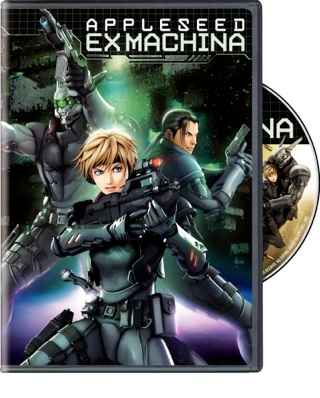
Produced by John Woo and directed by Shinji Aramaki, "Appleseed Ex Machina" (2007) ranks as the most elaborate, stylish, and violent of the three adaptations of Masamune Shirow's manga. When it was released in 1988, the original "Appleseed" felt like a summary of anime's past, while "Akira" pointed the way to the future. The second "Appleseed" (2004), also directed by Aramaki, was an unimpressive motion-capture CG feature that borrowed elements from other sci-fi anime. In this latest incarnation, Deunan, Briareos, and Tereus of the E.S.W.A.T. team are charged with preserving the peace of the city-state of Olympus, a hi-tech paradise on a largely ruined Earth. Screenwriters Kiyoto Takeuchi and Todd W. Russell have given the story a contemporary twist, adding attacks by "cyborg terrorists" and an effort by the ruler of Olympus to control a world-wide satellite surveillance system. When cyborgs and human launch coordinated attacks on the government headquarters in Olympus, Deunan, Briareos, and Tereus swing into action against a mysterious enemy. The plot has little in common with the earlier films: the Appleseed technology that was at the core of the story isn't even mentioned. The look, tone, and characters in "Ex Machina" recall Shirow's "Ghost in the Shell", rather than the original "Appleseed". Not surprisingly, the elaborately choreographed fight scenes reflect Woo's signature style, with slo-mo martial-arts combat, close-ups of falling shells, dynamic camerawork, and all-out gun battles. But the weightless movements of the motion-capture characters and the limited rendering of the skin textures gives "Appleseed Ex Machina" the feel of an extremely elaborate computer game. Despite the limits of the mo-cap technology, "Appleseed Ex Machina" is a fast-past, take-no-prisoners cinematic adventure that will delight action-movie fans as well as anime lovers. (Rated PG-13: violence, violence against women, profanity, grotesque imagery, potentially offensive religious imagery.) "--Charles Solomon"