Summary
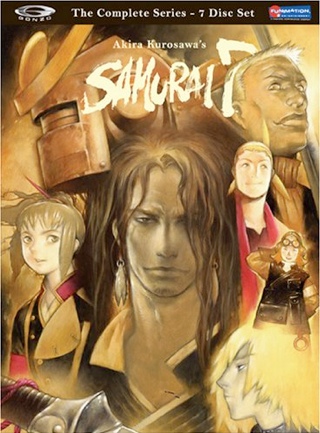
The broadcast series "Samurai 7" (2004) borrows the premise of Akira Kurosawa's "Seven Samurai" (1954): driven to desperation by bandits who steal their crops, the inhabitants of a small village hire unemployed samurai to defend them. With nothing to offer as wages but their precious rice, the villagers recruit warriors poor enough to accept the dishonor of working for peasants. "Samurai 7" moves the story into the future: the bandits and some of the samurai are "mecha". The grim ronin Kambei leads the viewers in the defense of their village, then tackles the forces of the orchidaceous emperor Ukyo. Kambei and his mismatched band attack the Capitol,Ukyo's equivalent of the Death Star. The warriors perform gravity-defying leaps, as they slash through steel plating, deflect bullets, and split laser beams with their swords in a climactic battle that occupies most of the last three episodes. The drawn/CG combinations reveal why "Samurai 7" cost a reported ¥32,500,000 (nearly $300,000) per episode, an extremely high price by Japanese standards.
Widely acclaimed as a masterpiece of world cinema, Kurosawa's "Seven Samurai" stressed the shared humanity of the peasants, the samurai, and even the bandits; the often grotesque people and "mecha" in this sci-fi adventure lack that essential bond. "Samurai 7" offers plenty of over-the-top battle sequences for viewers who enjoy a mixture of feudal and futuristic daring-do. But its meandering plot, stock heroes, and tin pot villains have very little to do with its supposed model. (Rated TV PG, suitable for ages 12 and older: violence, brief nudity, alcohol and tobacco use) "--Charles Solomon"